
Best Solutions For IPTV Subscription Billing
Thriving IPTV business? Explore the best solutions for IPTV subscription billing with Offshore Gateways – secure, fraud-resistant, dedicated.
The Ultimate Guide To Payment Gateways For Startups
Don’t let “payment gateways for startups” cripple your hustle. Secure transactions, diverse options, dedicated support – unleash your growth potential with the right partner.
How To Choose The Right Ecommerce Merchant Account For Your Business
Learn how to choose the right ecommerce merchant account for your business, with a focus on high-risk businesses.
Payment Gateway Integration: A Comprehensive Guide
Unlock secure and seamless online payments with our payment gateway integration – the essential choice for e-commerce success.
High Risk Merchant Accounts: What You Need to Know

Unlock the potential of high risk merchant accounts and expand your customer base with secure credit card processing solutions.
Open Banking For Forex and Crypto: A Game Changer In 2023
Experience open banking for forex and crypto with fast, secure solutions from Offshore Gateways.
10 Reasons Why Your Business Needs A Reliable Merchant Account
Discover the top 10 reasons why your business needs a reliable merchant account. Boost sales, enhance security, and expand globally.
The Best Merchant Account Services for 2026 for High-Risk Businesses
Find your ideal payment processing partner with the best merchant account services for high-risk industries in 2023.
Mastering 14 Basics: A Powerful Guide to Payment Gateway vs Payment Processor
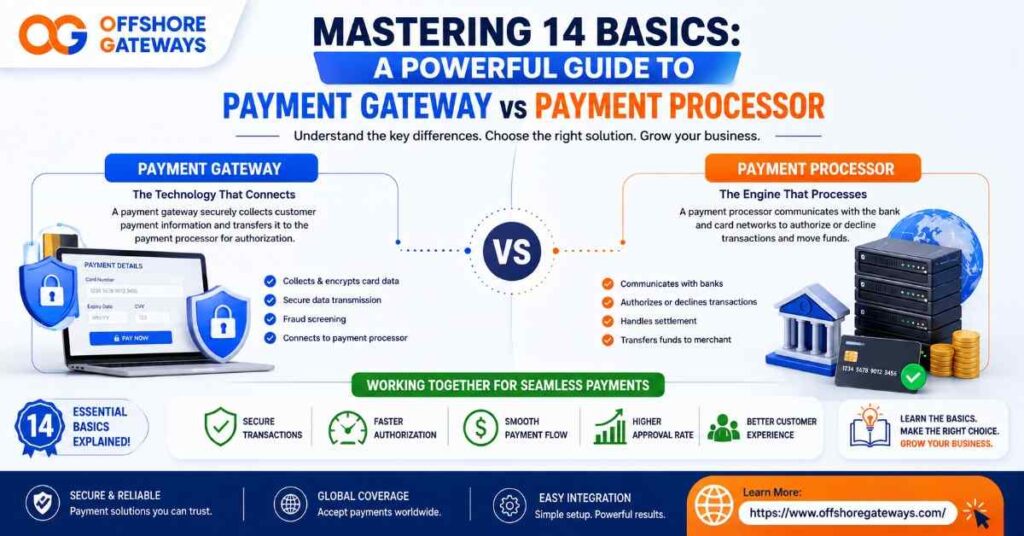
Mastering 14 Basics: A Powerful Guide to Payment Gateway vs Payment Processor In today’s hyper-connected world, the payment gateway vs payment processor play a vital role in ensuring the swift and secure flow of funds through online channels, catering to businesses and consumers alike. These often-confused elements have distinct functions that harmonize to create a seamless experience for digital transactions. This thorough exploration aims to demystify the realm of payment gateways and payment processors, shedding light on their individual roles, disparities, and the harmonious collaboration driving the realm of online payments. Payment Gateway VS Payment Processor At the core of digital transactions, payment gateway vs payment processor form essential pillars of the modern financial ecosystem. Although distinct, they collaborate seamlessly to enable online transactions. Payment gateway vs payment processor work in tandem to ensure the fluid exchange of funds in the digital realm. Payment gateways serve as virtual entrances, allowing customers to input payment information securely and initiate the transaction process. Payment processors take over after this point, verifying funds, validating details, and coordinating fund transfers between accounts. This collaborative dance between the two ensures the efficiency and security of online transactions, shaping the landscape of modern finance. 1. Definition and Functionality Aspect Payment Gateway Payment Processor Definition The engine behind transactions, verifies, transfers funds Engine behind transactions, verifies, transfers funds Functionality A bridge between customer, merchant, bank Verifies transactions, validates funds, initiates transfers Payment Gateways: Imagine a bridge that spans across customers, merchants, and banks, facilitating the smooth passage of payment information. This bridge is the payment gateway. Acting as a virtual intermediary, a payment gateway encrypts the transaction data as it travels from the customer’s device to the merchant’s platform. Payment Processors: While the payment gateway sets the stage, the payment processor steps into the spotlight backstage. It is the engine that drives the transaction process, ensuring its accuracy, validity, and completion. 2. Key Differences Aspect Payment Gateway Payment Processor Interface Focus Prioritizes user interface, checkout experience Backend processing, transaction verification Data Protection Ensures secure data transmission Implements fraud detection algorithms Payment Gateways: Going beyond the technical aspects, payment gateways prioritize user experience in the payment gateway vs payment processor arena. They are dedicated to streamlining the checkout process for customers, striving to make it as seamless and convenient as possible. Payment Processors: In the realm of payment gateway vs payment processor, the latter thrives behind the scenes, meticulously handling the intricate details of transaction verification. Their paramount responsibility revolves around ensuring the legitimacy of transactions. 3. Technological Infrastructure Aspect Payment Gateway Payment Processor Data Security Encryption protocols, SSL technology Fraud detection mechanisms, secure routing Integration Methods APIs, plugins, SDKs Direct connections with financial networks Customization Customization options for integration Collaboration with issuing banks, card networks Role in Transaction Front-end interface, data transmission Back-end processing, verification, fund transfer Payment Gateways: The architecture of a payment gateway is designed to prioritize data security and seamless integration. Encryption protocols, such as SSL (Secure Sockets Layer), are employed to create a secure connection between the customer’s device and the merchant’s platform. Payment Processors: Payment processors, in their pursuit of accuracy and security, establish direct connections with financial institutions. These connections enable rapid and precise transaction processing. 4. User Experience Aspect Payment Gateway Payment Processor Payment Options Offers diverse options (credit cards, wallets) Swift verification, seamless user checkout Payment Gateways: The success of an online payment system hinges on the user experience provided by payment gateways. Within the realm of payment gateway vs payment processor, payment gateways emerge as customer-centric champions. To reduce friction and enhance convenience, they offer a spectrum of payment options. Payment Processors: Payment processors collaborate closely with payment gateways to ensure accurate processing across diverse payment methods. They meticulously verify transactions and validate fund availability, regardless of the payment method chosen by the customer in the payment gateway vs payment processor dynamic. 5. Security Measures Aspect Payment Gateway Payment Processor Data Security Secure data transmission Fraud detection, secure transaction routing Payment Gateways: The security of customer data during transmission is a paramount concern for payment gateways. To mitigate risks, they employ encryption protocols such as SSL technology. Payment Processors: Payment processors are guardians of financial integrity. They utilize a multi-layered approach to security, involving advanced fraud detection algorithms. 6. Integration with E-commerce Platforms Aspect Payment Gateway Payment Processor Integration Methods APIs, plugins, SDKs Direct connections, seamless processing Payment Gateways: The integration of payment gateways into e-commerce platforms is vital for seamless online transactions. Payment gateways offer various integration methods, including APIs, plugins, and SDKs. Payment Processors: Payment processors collaborate closely with payment gateways to ensure secure transaction processing within the dynamic landscape of payment gateway vs payment processor. Their pivotal role includes meticulous verification of transaction details acquired from the payment gateway, guaranteeing utmost accuracy in the exchange of payment information. 7. Types of Payments Aspect Payment Gateway Payment Processor Payment Methods Supports various methods (cards, wallets) Accurate processing & supports multiple methods Payment Gateways: Payment gateways, in the realm of payment gateway vs payment processor, stand as symbols of flexibility. They empower businesses to provide an array of payment methods to customers, ranging from traditional credit and debit cards to digital wallets and even bank transfers. Payment Processors: Payment processors join forces with payment gateways to process various payment methods accurately. They verify transactions and validate the availability of funds, irrespective of the payment method chosen by the customer. 8. Transaction Speed and Reliability Aspect Payment Gateway Payment Processor User Experience Smooth checkout experience, presentation Swift verification, accurate fund transfer Payment Gateways: In the realm of online payments, speed is of the essence. Payment gateways contribute to a smooth transaction experience by promptly presenting payment options and simplifying the checkout process. Payment Processors: Payment processors play a critical role in ensuring the reliability of transactions. Their real-time verification processes prevent delays and inaccuracies in fund transfers. 9. Cost and Fees Aspect Payment Gateway Payment Processor Pricing Models Transaction fees, subscription-based Transaction percentage, risk-based fees Payment Gateways:
Do You Know These 10 Essential Payment Security Measures?
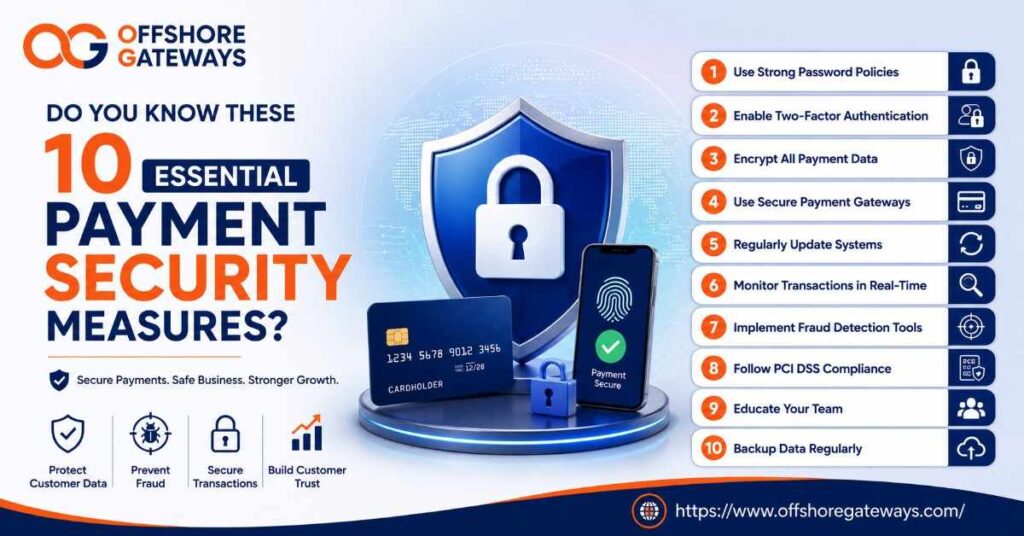
Protect cardholder data using Payment Security by Offshore Gateways. Learn about Data Encryption, PCI Compliance & more for a secure and flourishing business.