
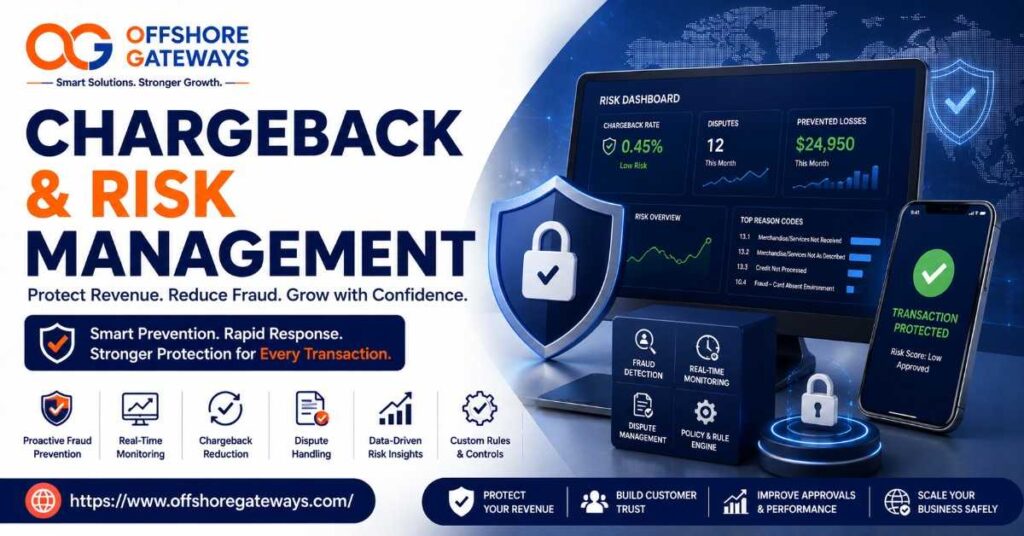
Reduce disputes at the source with professional chargeback and risk management – layered prevention, real-time monitoring, and expert representment for high-risk commerce.
Chargeback management is not a single tool — it is a stack. Alerts alone intercept disputes before they hit your ratio, but merchants relying only on alerts end up refunding cases they could have won. Representment alone fights disputes after the fact, but even a strong case yields a net recovery rate of roughly 18% once second-cycle disputes and non-responses are factored in. The only approach that consistently lowers your dispute ratio and recovers revenue is layered: pre-transaction fraud detection, issuer-network alert integration, and automated representment working together. For merchants running a high-risk subscription service, a gaming platform, or a cross-border e-commerce store, this is what how to prevent chargebacks actually means in practice — not one tool, but a connected workflow that stops friendly fraud, true fraud, and clerical errors at each stage, while keeping authorisation rates and issuer trust healthy.
If your chargeback ratio is already above 0.9% (Visa threshold) or 0.75% (Mastercard threshold), you are in urgent territory — acquirers impose fines and monitoring programs at these levels, and account termination follows if ratios stay elevated. See how our credit card processing setup includes acquiring relationships specifically built for high-risk merchants who need stable ratios to stay processing.
Pre-transaction screening, issuer-network integration, and post-dispute representment — combined so your team sees fewer chargebacks, wins more cases, and keeps authorisation rates stable. Unlike a basic fraud filter that blocks and forgets, this is a continuous loop: dispute data feeds back into fraud rules, fraud trends inform alert thresholds, and everything is tuned to your specific business model.
Different industries hit different chargeback triggers. Gaming disputes come from deposit confusion and friendly fraud. Subscription disputes come from forgotten renewals. B2B disputes come from missing paper trails. A single rule set handles none of these well — which is why each vertical below gets its own framework.
These are the verticals where standard fraud filters get over-tuned — blocking legitimate cross-border traffic while still missing the actual fraud. Our high risk payment gateway fraud framework runs AVS/CVV checks, device and IP intelligence, velocity and amount limits, and selective 3DS: applied tightly where fraud risk is real, loosened where blocking legitimate players costs you more than it saves. For gaming specifically, we configure casino-level velocity rules (example: maximum 3 deposits per hour per player) and adult-content billing descriptors structured to pass bank filters without triggering generic “suspicious merchant” flags. For crypto-funded gaming accounts, KYT screening runs on every deposit — see our crypto payment solutions page for how that integrates. For CBD, hemp, and nutraceuticals — where card not present fraud and trial-offer friendly fraud both run high — we pair pre-transaction screening with chargeback alerts so disputes get intercepted before they hit your ratio.
35% of cardholders find canceling subscriptions “somewhat difficult” or “very difficult” — and when they can’t cancel easily, they call their bank instead. That’s the core subscription chargeback problem, and it’s mostly preventable. We tackle it at three points: before billing (pre-renewal reminders sent 3-5 days out, so customers aren’t surprised), at billing (clear descriptors that match what the customer remembers signing up for — 80% of consumers say clearer merchant information would reduce their disputes), and after billing (a self-service cancellation portal so frustrated customers can cancel themselves instead of disputing). 67% of customers prefer self-service over speaking with a support rep — a portal that actually works removes the single biggest trigger for “I forgot to cancel” chargebacks. For renewal failures, pre-dunning emails and failed payment retry logic close the gap before the customer notices a broken charge and escalates. Merchants implementing billing descriptors, trial reminders, and one-click cancellation typically see chargeback rates drop 35% within 60 days. Step-up authentication is applied only for risky renewal cohorts — not blanket, which would tank approvals.
High-ticket payment fraud disputes are winnable — if you have the right evidence. Pre-transaction screening (AVS, device checks, signed terms at checkout) reduces fraud attempts getting through in the first place. When a chargeback does land, automated evidence packs pull PDF invoices, signed purchase orders, proof-of-delivery with carrier and signature confirmation, and email correspondence showing the customer explicitly approved the charge. For digital goods and access-based products, usage logs (login timestamps, feature activity, download records) demonstrate the customer benefited from the purchase during the disputed period — one of the strongest arguments available in representment. Connect this to your merchant bank account settlement data for a complete dispute audit trail.
Engagement starts with a dispute diagnostic, not a sales call. We map your current chargeback reason codes, fraud sources, and rule gaps before deploying anything — because the right tool for a gaming operator running high-volume crypto deposits looks nothing like the right tool for a B2B seller with signed invoices. This is a continuous merchant risk assessment cycle, not a one-time setup.
The honest comparison: processor chargeback fees alone average $110 all-in per dispute (Mastercard, 2025), with total costs reaching $128 when fulfillment, staff time, and lost goods are included. For high-risk merchants already paying $50-$100+ per dispute, one month of elevated ratios can cost more than a year of professional chargeback protection services. If your ratio crosses 0.9% and you enter Visa’s VDMP monitoring program, fees escalate to $50 per chargeback in months 5-9, plus a $25,000 monthly review fee from month 10 onward. Professional management pays for itself quickly against that math.
Controls follow card-network rules and regional law – data is minimised, encrypted, and never stored beyond what dispute evidence actually requires. When you engage a risk management service for payments, the compliance infrastructure behind it matters as much as the fraud tools themselves.
Chargeback management is the process of preventing disputes before they happen and fighting back when they do - through fraud screening, issuer-network alerts, and automated representment. High-risk merchants need it more than most because their dispute rates are naturally higher: gaming, forex, CBD, and subscription businesses all face chargeback rates that can hit 1-2%, well above the 0.9% threshold where Visa starts applying fees and monitoring-program penalties. Without a structured management layer, one bad month can trigger acquirer restrictions or account termination.
A refund is initiated by the merchant - you return the money directly to the customer, the transaction is closed, and no third party is involved. A chargeback is initiated by the customer's bank - the bank forcibly reverses the payment, charges you a dispute fee ($20-$100 typically), and the reversal counts against your chargeback ratio regardless of whether you win the representment. A chargeback costs you the sale, the product, the fee, and ratio health. A refund costs you only the sale. For most disputes, issuing a fast refund is cheaper than fighting a chargeback - which is exactly what pre-dispute alert tools are designed to help you do.
Friendly fraud is when a customer disputes a legitimate transaction - either intentionally (keeping goods while claiming non-receipt) or accidentally (not recognising the charge on their statement). It now accounts for roughly 36% of all reported fraud globally, up from 15% in 2023. Prevention requires clear billing descriptors that match what the customer remembers buying, pre-renewal reminders for subscription businesses, and delivery/usage evidence stored at transaction time - so if a dispute is filed, you have proof the customer received and used the product.
The timeline depends on the card network and reason code. Merchants typically have 20-45 days to respond to a dispute notification once it arrives - but Visa's 2025 fee changes mean costs escalate if you respond after day 10. After submission, issuers usually rule within 30-45 days, though pre-arbitration cases can take longer. The practical implication: you need evidence assembled and submitted fast, which is why automated evidence packs matter - manual gathering under a 10-day effective window fails more often than it should.
Visa's VAMP program flags merchants at 0.9% (excessive threshold from January 2026), applying a $10 fee per disputed transaction above that level. Mastercard's ECM program triggers at 1.5% for two consecutive months, with fines starting at $1,000 in month 2 and escalating to $5,000/month by month 4. Most acquirers set their own internal limits below the card-network thresholds - meaning your account can face restrictions before you technically breach the published numbers. For high-risk merchants, staying below 0.75% is the practical safe zone.
Not every chargeback is worth fighting. The decision depends on transaction value, your win probability for that reason code, and the cost of representment itself. A $40 dispute with a 20% win probability and $15 in representment fees is a net loss to fight. A $400 dispute with valid tracking and delivery confirmation is worth every effort. The right approach is a triage system - auto-accept low-value or low-evidence disputes, fight high-value cases with strong evidence, and use pre-dispute alerts to intercept everything else before it becomes a formal chargeback at all.
Connect With Us

Market coverage, supported banks, and an integration plan within 24 hours.
Enabling fast, secure payments and tailored solutions—empowering your business to grow worldwide, no matter the challenge.
Copyright © 2026. All rights reserved.