
Why Your Low-Risk Cross-Border Business Is Considered High Risk
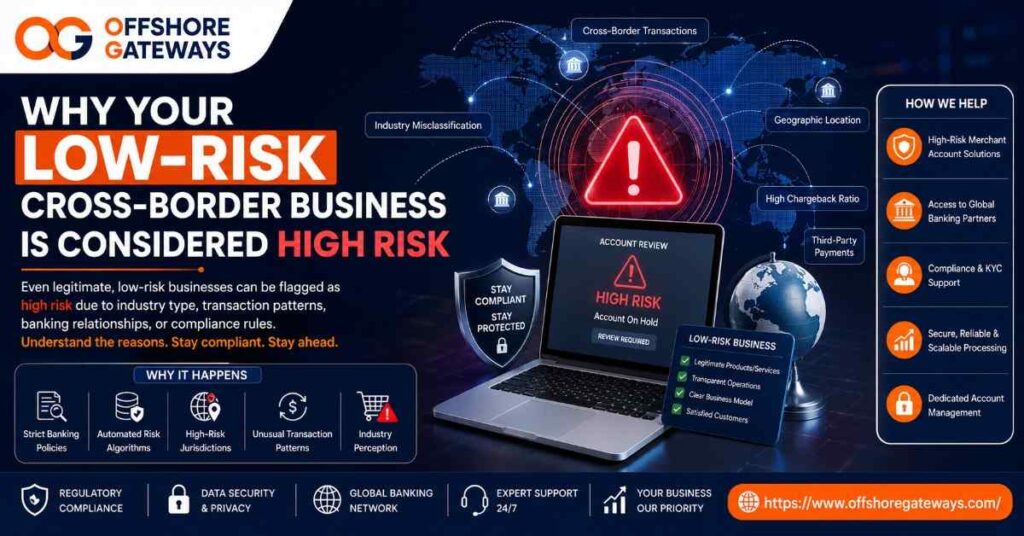
Why Your Low-Risk Cross-Border Business Is Considered High Risk With the expansion of globalization in the contemporary world, companies of all sizes stretch into every conceivable pocket of the world. Cross-border transactions undoubtedly hold tremendous potential; however, for a significant proportion of low-risk businesses, their activities are flagged as high risk by financial institutions. Such a classification often becomes a challenge when they seek out an e-commerce merchant account for payment processing. This blog will explore the reasons why this is categorized that way, and how Offshore Gateways can help secure a merchant account for your business. Understanding Merchant Account Risk Categorization Since a merchant account essentially allows businesses to process credit and debit card payments, there is an added need for e-commerce payment processing. Although financial institutions consider the risk involved in processing the payment prior to opening an account, businesses operating with cross-border transactions do face problems with: 1. Regulatory and Compliance Concerns Payment service providers face many different local regulations across various countries. It isn’t until businesses engage in cross-border, low-risk transactions that regulatory variation often causes complexity and ‘perceived’ risk. 2. Chargebacks and Refunds Cross-border payments may be more prone to dispute because of currency conversions, delayed deliveries, or miscommunications. High chargeback rates, even if unintentional, may negatively brand your business as high risk. 3. Fraud Prevention Whether big or small, e-commerce firms stand a great risk of being cheated while undertaking their international business. The service providers demean the businesses as high-risk in a bid to reduce their losses. Low-Risk Merchant Accounts: Why They’re Classified as High Risk Some reasons why your business is still on the high-risk book include the following: 1. Cross-Border Transactions It makes cross-border transactions seem very expensive since payment processors vary with regards to their standards for paying, currencies, and fraud detection, meaning your business is most likely bound to be classified as high risk. 2. Industry-Specific Risk Examples of higher-risk businesses include subscription-based services or digital goods: whatever the operational integrity of that business may be, to secure a merchant account in this regard, it will be more difficult for your online business. 3. Lack of Financial History High-risk classification, due to very few transactional records, may be assigned to start-ups or a firm because the providers can’t tell much about its stability and reliability. 4. Jurisdictional Concerns Your business could easily be classified as high-risk by payment processors by countries that have more relaxed financial regulations because the need to protect their operations must be fulfilled. The Impact on E-Commerce Payment Processing Getting labeled as high risk can dramatically affect your e-commerce business. Some frequent problems include: Higher Fees: The accounts for high-risk merchants charge relatively higher transaction fees and opening charges. Limited Provider Options: Not all payment processors service high-risk businesses. Delayed Settlements: Cross-border transactions may face additional scrutiny, delaying fund settlements. How Offshore Gateways Can Help Your Business Specialized in supporting businesses classified under high-risk at Offshore Gateways, we will guide you through the management of business offers that have low-risk cross-border transactions, or an e-commerce store on a lookout for a reliable payment solution. 1. Expertise in Cross-Border Transactions We understand the problem in globalization and offer products to make your payment processes smooth and easier. 2. High-Risk Merchant Account Setup Our company works along with established financial institutes to obtain a merchant account for your company, ensuring compliance and minimizing the risks. 3. Fraud Prevention Tools We build advanced fraud detection and prevention measures to keep your business and customer trust safe. 4. Transparent Pricing Offshore Gateways has transparent pricing for payment processing without any concealed fees. Why Partner with OffshoreGateways? Here’s why OffshoreGateways is the ideal partner for your business: Customized Solutions: Our company studies your individual needs and provides suitably customized solutions to tackle your problems. Global Network: We work with global banks and payment service providers to ensure easy cross-border transactions. End-to-End Support: They are available throughout the accounts, from setup to current management. ORM Integration: Apart from processing your payments, we integrate ORM to ensure that the reputation of your brand is protected. Steps to Secure Your Merchant Account with OffshoreGateways 1. Consultation:- Customer should arrange a call to discuss his/her business model and payment needs with our team. 2. Documentation:- Carry all essential documents to support the case, for example, financial statements, compliance certificates, etc. 3. Application Submission:- We contact the payment providers and submit your applications and negotiate favorable terms. 4. Account Approval:- We install the payment gateway in your website’s e-commerce platform after approval for smooth transactions. Conclusion Though it may be a bad blow to have your business categorized as high risk, let this setback not discourage you from expanding. OffshoreGateways is aware of the fact that businesses such as yours require help in driving over-transactions across borders for you to succeed. If your low-risk business is facing challenges securing a merchant account for e-commerce payment processing, contact Offshore Gateways today. Let us turn your payment challenges into opportunities for growth. Stay updated on social media as well – Linkedin Frequently Asked Questions Why is my low-risk business classified as high risk by payment processors? Even if your business operates with integrity, factors such as cross-border transactions, industry-specific risks, chargeback rates, and jurisdictional concerns can lead to a high-risk classification. Payment processors often take a cautious approach to minimize potential losses. What challenges do high-risk businesses face in securing a merchant account? High-risk businesses often deal with higher transaction fees, limited payment processor options, and delayed settlements. These challenges arise from the perceived risks involved in processing payments for such businesses. How does OffshoreGateways help businesses classified as high risk? OffshoreGateways specializes in assisting high-risk businesses. They provide customized solutions, fraud prevention tools, and transparent pricing. Their expertise in cross-border transactions ensures smooth and efficient payment processing. What documents are required to secure a high-risk merchant account? Essential documents include financial statements, compliance certificates, proof of business registration, and any previous transactional history. Offshore Gateways guides
Managing Cross-Border Payment Challenges in International Casinos
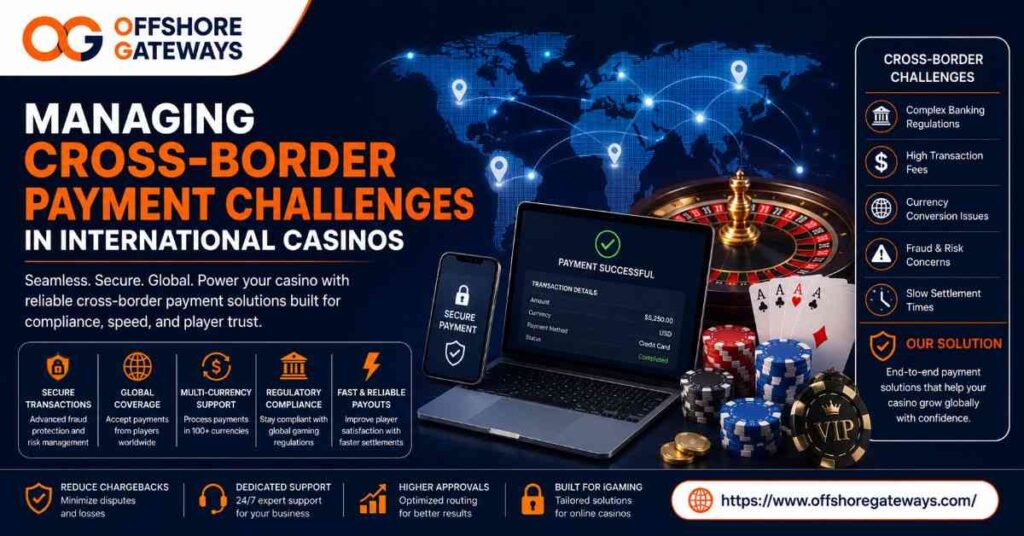
Managing Cross-Border Payment Challenges in International Casinos International online casinos have become a popular platform for gambling enthusiasts worldwide. However, one of the most significant hurdles they face is cross-border payment challenges. As more players engage with international casinos, ensuring smooth and secure transactions is crucial. In this article, we will explore the common cross-border payment challenges these casinos encounter and how solutions like Offshore Gateways can help overcome them. Understanding Cross-Border Payment Challenges With the global expansion of online casinos, facilitating secure and efficient cross-border payments has become a priority. cross-border payment challenges include issues related to currency conversion, regulatory compliance, fraud prevention, and payment processing. Addressing these challenges is necessary for providing a Smooth gaming experience to international players. 1. Currency Conversion Issues One of the most common cross-border payment challenges is handling multiple currencies. Players from different countries want to deposit and withdraw money in their local currencies. However, converting these funds often incurs fees and exchange rate fluctuations, which can impact the player’s winnings. For online casinos, managing these changes is important to maintaining customer satisfaction. Payment solutions that offer real-time currency conversion can minimize costs and improve the user experience. 2. Regulatory Compliance and Licensing The gambling industry is highly regulated, and each country has its own set of laws regarding online gambling. International casinos must comply with the legal requirements of every jurisdiction they operate in. This includes Know Your Customer (KYC) checks, Anti-Money Laundering (AML) regulations, and ensuring secure payment gateways. Non-compliance can lead to large fines, legal issues, or even bans from operating in specific regions. Therefore, it is important for casinos to partner with reliable payment providers who understand the regulatory landscape and can ensure compliance. 3. Fraud Prevention and Security Security concerns are a significant part of cross-border payment challenges. With the rise of cyber threats, international casinos must take proactive measures to prevent fraud. Implementing advanced encryption and authentication protocols is necessary to protect user data and prevent unauthorized transactions. Casinos should consider using fraud detection systems that can identify suspicious activities in real-time. This can include monitoring for unusual transaction patterns or declining accounts that attempt to bypass security protocols. 4. Payment Processing Delays Payment processing delays can frustrate players and cause them to abandon the platform. International transactions often take longer due to differences in banking systems, time zones, and verification procedures. This can lead to dissatisfaction among users who expect instant deposits and withdrawals. To resolve these cross-border payment challenges, casinos can partner with efficient payment providers who specialize in processing international transactions swiftly. Offshore Gateways, for instance, offers optimized solutions to reduce delays and enhance the customer experience. Strategies to Overcome Cross-Border Payment Challenges To thrive in the competitive international casino market, overcoming payment hurdles is crucial. Here are some strategies that online casinos can adopt: 1. Partnering with Global Payment Providers Teaming up with trusted global payment providers can significantly reduce cross-border payment challenges. These providers have the expertise and infrastructure to handle international transactions, ensuring seamless currency conversions, regulatory compliance, and fraud prevention. Offshore Gateways is a leading solution in this space, offering specialized services to help casinos streamline their payment processes. 2. Implementing Multiple Payment Methods Offering diverse payment options is important for accommodating players from various regions. Besides credit and debit cards, casinos should support alternative methods such as e-wallets, cryptocurrencies, and bank transfers. This flexibility can improve user satisfaction and attract a broader audience. Cryptocurrencies in particular, have gained popularity among online gamblers due to their Obscurity, low transaction fees, and faster processing times. Integrating crypto payment options can help casinos overcome some cross-border payment challenges by providing a decentralized, borderless payment solution. 3. Utilizing AI for Fraud Detection Artificial Intelligence (AI) and machine learning are transforming the way casinos detect and prevent fraud. By analyzing transaction data and identifying patterns, AI systems can flag suspicious activities, reducing the risk of financial losses. Leveraging these technologies helps international casinos stay ahead of potential security threats. 4. Streamlining KYC Processes Efficient KYC procedures are vital for ensuring regulatory compliance while reducing friction for users. Implementing automated KYC solutions can speed up the verification process, making it easier for players to start gambling while adhering to local laws. Offshore Gateways provides streamlined KYC services that enable casinos to onboard players quickly without compromising on security. Benefits of Overcoming Cross-Border Payment Challenges Addressing cross-border payment challenges can bring numerous benefits to online casinos: Improved Player Retention: By offering smooth and secure payment processes, casinos can enhance player satisfaction, leading to better retention rates. Increased Revenue: Efficient cross-border payments enable casinos to tap into new markets, expanding their player base and increasing revenue. Enhanced Security: Implementing robust security measures helps protect both the casino and its players, building trust and credibility. Future Trends in Cross-Border Payments for International Casinos As technology evolves, the future of cross-border payment challenges in the online gambling industry is set to change. Here are some trends to watch out for: 1. Blockchain and Cryptocurrency Adoption The adoption of blockchain technology and cryptocurrencies is expected to increase as online casinos seek secure, transparent, and cost-effective payment solutions. Blockchain’s decentralized nature offers enhanced security, while cryptocurrencies enable faster and cheaper cross-border transactions. 2. Biometric Verification Biometric technology is gaining traction in the gaming industry. Fingerprint scans, facial recognition, and voice recognition can enhance KYC processes, making them more secure and efficient. This can help casinos reduce fraud while providing a smoother user experience. 3. AI-Driven Payment Systems AI-driven payment systems are becoming more prevalent in tackling cross-border payment challenges. These systems can optimize transaction speeds, reduce processing costs, and provide real-time fraud detection, benefiting both casinos and their customers. Conclusion Managing cross-border payment challenges is essential for the growth of international casinos. By adopting the right strategies and partnering with experts like Offshore Gateways, casinos can ensure smooth, secure, and efficient payment processes. This not only improves the user experience but also drives long-term profitability. Offshore Gateways stands out as
Step by Step Guide to Setting Up an International Payment Gateway for Beginners
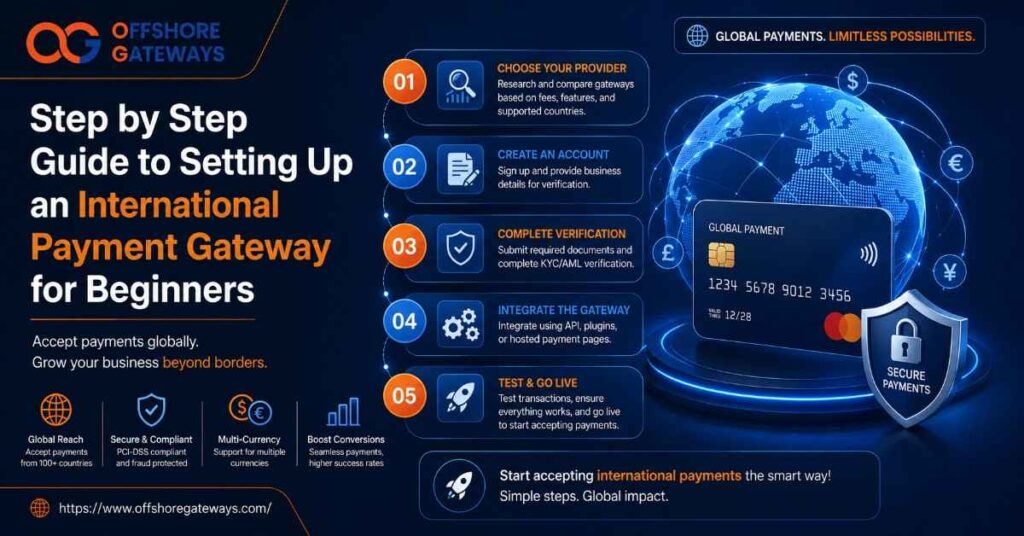
Guide to Setting Up International Payment Gateways Easy Fast Setting up an international payment gateway can be a game changer for businesses aiming to expand globally. A smooth and secure payment process encourages customer trust and drives sales. In this comprehensive guide, we walk you through the steps of implementing an international payment gateway for your website, with practical advice and essential considerations to ensure success. What is an International Payment Gateway? An international payment gateway is a technology solution that enables businesses to accept payments from customers worldwide. It handles multiple currencies, supports various payment methods, and ensures secure transactions. By integrating this system, you open your business to a global audience, simplifying payment processes for customers from different countries. Why You Need an International Payment Gateway Expanding your business globally necessitates a reliable way to process payments from international customers. Here’s why: Essential Features to Look for in an International Payment Gateway Choosing the right international payment gateway involves understanding your business needs. Here are key features to consider: Step by Step Guide to Setting Up an International Payment Gateway 1. Research and Choose the Right Payment Gateway Provider Start by researching numerous international payment gateway providers. Consider the following aspects: 2. Set Up a Merchant Account Most online payment gateway providers require you to have a merchant account. A merchant account acts as an intermediary that holds funds temporarily until they are transferred to your business bank account. To set up a merchant account: 3. Integrate the Payment Gateway with Your Website To start accepting payments, you will need to integrate the gateway into your website. Here’s how: 4. Customize the Payment Experience An intuitive and user-friendly payment experience can significantly improve customer satisfaction. Focus on: 5. Implement Strong Security Measures Security is paramount when dealing with sensitive financial information. To protect your customers: 6. Enable Multi-Currency Processing One of the primary benefits of an international payment gateway is the ability to handle multiple currencies. Here’s how to implement it: 7. Comply with International Regulations International transactions are subject to various regulatory requirements. Be sure to: White Label Payment Gateway Options If you are considering a more branded experience, explore white label payment gateway solutions. These allow businesses to customize the gateway interface with their branding. Here’s why a white label payment gateway might be advantageous: Benefits of Using an Online Payment Gateway A well integrated online payment gateway comes with numerous advantages: How Offshore Gateways Can Help At Offshore Gateways, we specialize in setting up reliable and secure international payment gateway solutions tailored for businesses of all sizes. Our services include: Common Challenges and How to Overcome Them 1. Currency Fluctuations Managing currency conversions can be tricky. Use a payment gateway that offers real-time conversion rates to minimize losses due to variation. 2. Security Threats Fraud is a significant concern in online transactions. By implementing features like tokenization and two-factor authentication, you can mitigate these risks. 3. Regulatory Compliance Staying compliant with international regulations requires ongoing attention. Partner with an experienced provider like Offshore Gateways to stay updated and compliant. Conclusion Setting up an international payment gateway might seem overwhelming initially, but with the right steps and support, it can greatly enhance your global business operations. By focusing on security, compliance, and customer experience, you pave the way for seamless and successful international transactions. At Offshore Gateways, we are here to simplify the process and ensure your business can thrive on a global scale. Stay updated on social media as well – Linkedin
The Complete Step-by-Step Guide to Setting Up a Merchant Account for Small Business
In today’s highly competitive market, having the ability to accept credit and debit card payments is important for any small business. To make this possible, you will need to set up a merchant account for small business. A business merchant account acts as a bridge between your company, your customers and the banks that handle transactions. Whether you are running a brick and mortar store or an online business, understanding how to set up a merchant account for small business can significantly enhance your payment processing capabilities. This comprehensive guide will walk you through the entire process of creating a merchant account for small business, ensuring you are equipped to accept payments smoothly and securely. What is a Merchant Account for Small Business? A merchant account is a type of bank account that allows your business to accept and process electronic payment transactions, specifically credit and debit cards. When customers pay for goods or services using their cards, the payment is processed through the merchant account before being transferred to your business’s primary bank account. Essentially, it serves as a holding place for the funds from these transactions. For small businesses, obtaining the best merchant account for small business is necessary to offer convenience and build trust with customers. It not only allows them to pay with their preferred methods but also speeds up transactions, increases sales, and improves cash flow. Why Do You Need a Merchant Account for Your Small Business? Having a merchant account for small business provides a multitude of benefits: Step-by-Step Guide to Setting Up a Merchant Account for Small Business Step 1: Determine Your Business Needs Before applying for a merchant account for small business, it is necessary to understand your payment processing needs. Ask yourself: Understanding these aspects helps in finding the merchant account for small business that caters to your specific needs. Step 2: Choose the Right Merchant Account Provider Selecting the right provider is key to successful payment processing. Not all merchant service providers are created equal, and choosing the wrong one can result in higher fees, poor customer service, or limited functionality. When evaluating providers, consider the following: Some of the best merchant account for small business providers include PayPal, Square, and Stripe, all of which are known for their transparency and scalability for small businesses. Step 3: Gather the Required Documentation Once you have chosen your provider, the next step is to gather all necessary documentation. Typically, you will need: Having these documents ready can speed up the approval process for your merchant account for small business. Step 4: Apply for the Merchant Account Once you have everything ready, you can apply for your merchant account. The application process is usually straightforward and can be done online. You will need to fill in your business details, provide the necessary documentation, and select the payment processing options that suit your business. Some providers offer instant approval, while others may take a few days to process your application. During this time, the provider will assess your business’s financial health, credit history, and the risk associated with processing payments for your industry. Step 5: Set Up Your Payment Processing System After your merchant account is approved, the next step is setting up your payment processing system. Depending on your business type, this could include: Many merchant account for small business providers offer user friendly dashboards that allow you to monitor transactions, refunds, and chargebacks in real time. Step 6: Test Your System Before going live, ensure that your payment processing system is fully operational. Test a variety of transactions, including credit cards, debit cards, and mobile payments, to verify everything works smoothly. You do not want any glitches when customers start making real purchases. Step 7: Start Accepting Payments Once you’ve tested the system, you are ready to start accepting payments! Make sure you train your staff on how to use the POS system or online gateway properly to avoid any disruptions in service. Having a functional business merchant account means your customers can now easily pay for your products or services, both in-store and online. Types of Merchant Accounts for Small Business Not all merchant accounts are the same. Depending on your business structure, there are different types of merchant accounts that might suit your needs: Choosing the best merchant account for small business depends on the nature of your operations and how you interact with your customers. Fees Associated with a Merchant Account for Small Business Understanding the fees associated with a merchant account for small business is important to managing costs. Some of the most common fees include: Be sure to read the fine print of your contract to understand all the fees involved. How Offshore Gateways Can Help At Offshore Gateways, we specialize in providing merchant accounts for small business to help entrepreneurs securely accept payments, whether they operate in traditional or high-risk industries. Our team works diligently to offer flexible solutions, competitive rates, and excellent customer service. Whether you are just getting started or looking to upgrade your current payment system, Offshore Gateways is here to assist you every step of the way in finding the best merchant account for small business. Let us streamline your payment processing, so you can focus on growing your business. Conclusion Setting up a merchant account for small business does not have to be complicated. By following the steps outlined above, you can get your account set up quickly and start accepting credit card payments, improving your cash flow and customer satisfaction. If you are ready to take the next step and get started with the best merchant account for small business, contact Offshore Gateways today and let us help you set up the right payment solutions for your business! Frequently Asked Questions (FAQs)
Smart eCheck Payment Solutions for London Businesses
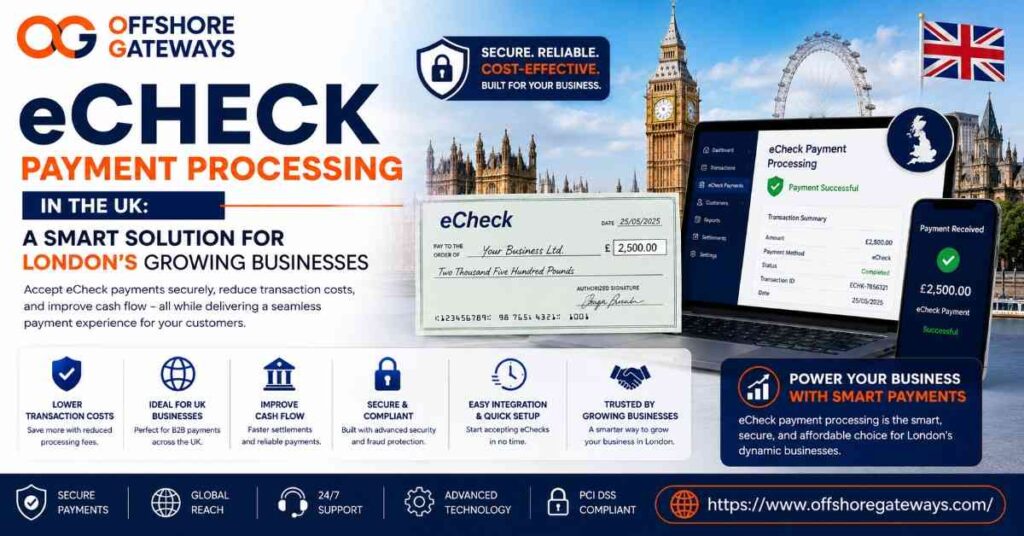
Smart eCheck Payment Solutions for London Businesses Increased growth of businesses in London, there has possibly never been this huge demand for alternative payments. Increasingly digitized business environments, the present highly digitized business environment looks forward to swiffer, safer, and cheaper ways of processing payments. In this context, one of the successful emerging solutions is the eCheck payment processing, which is an efficient and reliable means of payment processing growing in popularity in the UK market. In this article, we will discover the essential benefits of eCheck payment processing and how it works and why it is now becoming a smart solution for London’s growing businesses. What is eCheck Payment Processing? This is an eCheck payment processing, a digital version of a paper check, offered to businesses as the opportunity for accept eCheck payments electronically. It enables customers to transfer funds directly from their bank accounts via an e-check. Therefore, it streamlines it, makes it secure, and cheaper compared with card payments and other payment alternatives. By using the ACH network, eChecks enable online electronic funds transfers, thus removing the need for paper-based processing. The facility of pay with eCheck online has provided businesses in London and the rest of the UK an easy way to receive payments from customers, who are also accommodated by the flexibility and convenience that this method of payment can afford. How Does eCheck Payment Processing Work? E-check payment processing is quite a simple process and comprises four basic steps: Authorization: In this way, the payer grants authorization for the transaction through an online form or by phone. Submission: According to eCheck, the company presents the payment information which contains details of the account and the sum to be withdrawn. Processing: ACH network processes the transaction, confirms ownership of account and verifies that the available balance is available for a transaction. Completion: Once confirmed, the funds are transferred out of the payers account to the business account usually within 3-5 working days. With the establishment of pay with eCheck online, the process is complete in a very short period, even under minutes, making it fast and easy to carry out payments without seeking the hassle of dealing with a traditional check or card-processing fees. Benefits of eCheck Payment Processing for London Businesses 1. Cost-Effective Solution One reason eCheck payment processing remains a favorite among companies is that it is cost-friendly. Companies spend a lot on traditional credit card processing fees, especially for small and medium enterprises. eChecks often have lower transaction fees compared to other forms of payment processing which translates to considerable savings by companies, particularly big ones. 2. Enhanced Security The handling of financial transactions always raises a great issue of security. eCheck payment processing uses the ACH network, which operates according to very strict guidelines so that the safety and security of each transaction is maintained. Thanks to technologies of encryption and tokenization, businesses as well as customers can be assured of high protection for their sensitive banking information. What is more, eCheck payments greatly reduce possibilities of fraud in comparison with credit card payments. A more strict verification process is used before an eCheck payment can be done. More assurance means that businesses can concentrate on expanding their businesses. 3. Improved Cash Flow Management The aspect of E-check payment processing is very convenient while making transactions in business cash flow management conducted within the fast-moving environment of London city as it yields a predictable and stable cash flow than the traditional methods. accept eCheck payments ensures that firms are paid when they should be paid because it is done automatically-meaning very little room exists for delay. This also simplifies the billing cycle of businesses and improves cash flow controls because, apart from recurring billing, the service supports automated payment schedules. 4. Convenience for Both Businesses and Customers It is very convenient to pay with eCheck online. To the consumer, this is easy; payments are done without necessarily requiring physical checks or cash, much to the benefit of businesses in terms of quicker payment processing and minimal administration. The flexibility or convenience of offering various payment options, such as ECheck, adds advantage to the mixed clientele of businesses in London. The more customers need an alternative means of payment, the more it gives them an edge over their competitors by providing this facility through eChecks. eCheck vs. Other Alternative Payment Methods Although eCheck payment processing is increasing in popularity today, the following still needs to be understood in light of other alternative payment methods, including credit cards, PayPal, and cryptocurrency. eCheck vs. Credit Card Payments As much as credit cards remain one of the favorites of consumers for payment, they still carry high transaction charges and chargeback risks. On the other hand, even the fact that eChecks will offer fewer fees, few chances of chargebacks makes them better alternatives for businesses seeking to reduce processing costs. eCheck vs. PayPal While many customers and corporations prefer using PayPal, at times its fees are extremely high compared to generally what is associated with eCheck payment processing. In addition, eChecks allow business people to have more control over the transactional operation because they are directly linked to bank accounts and free from third party websites like PayPal. eCheck vs. Cryptocurrency Payment for Cryptocurrency is on the rise, particularly among savvy customers, especially when it comes to technology. However, digital currencies do offer decentralized and secure modes of performing payments, but it lacks the regulatory basis and stability that eCheck payments enjoy. Businesses focusing on dependability and financial rules compliance would be safer and stable with eCheck payment processing. Who Can Benefit from eCheck Payment Processing? eCheck payment processing is a dynamic solution for any kind of business and whether it is an e-commerce start-up or a service provider with huge business, the ability to accept eCheck payments can really enhance the options of payment and help smoothen out operational activities in many industries: E-commerce businesses: Retailers sell through the Internet and provide pay with
Which is the Best Payment Gateway in Southampton with easier integration?
A payment gateway is that technology which enables merchants to accept online payments. It acts as an intermediary between the customer and the merchant’s bank, processes the customer’s card details safely, and ensures an approved transaction for the merchant. The former is as cryptic as it is sensitive, so less likely to solicit fraudsters. Any business, whether selling through its eCommerce site, mobile application, or just in-store systems, requires a payment gateway. As there are many in the market, easy to use, integrate and even have good customer support, it would qualify as the best payment gateway in Southampton. Why Choosing the Right Payment Gateway Matters A pretty big technical detail would be the smoothness of the payment experience, but what might literally break or make your business is what might just mean the difference between a quick, smooth transaction and one that feels clunky or unsafe—can make or break which consumer returns. In actuality, the best payment processor for your business lies at the intersection of ease of use, security, and flexibility. Therefore you would want to have a gateway which can easily slot into your current platform, without wasting hours pouring over technical glitches or fending off complaining customers. Key Features to Look for in the Best Payment Gateway in Southampton If you wish to find the best payment gateway in Southampton, then look at these following feature areas. 1. Security Security is not compromise-able. Look for a payment gateway offering strong security solutions, such as supporting SSL encryption and PCI-DSS compliance. This simply means that your customers’ sensitive data would be encrypted to prevent fraud. 2. Ease of Integration Any business shouldn’t make integration with a payment gateway too tough. Either on Shopify, or on WooCommerce, or custom platforms, this best payment gateway has to come along with well-defined, comprehensive APIs or plugins to ensure they easily integrate with other systems. 3. Customer Support Responsive customer support is very important. In case of a payment error, quick and knowledgeable support will enable you to get help in the shortest time possible. Support those gateways that can give you 24/7 support, especially if you are working outside regular hours. Top Payment Gateways in Southampton Which are the best payment gateways that businesses in Southampton can use? In-depth analysis of the front runners: 1. Stripe Stripe is sometimes the friendliest option to a developer, as well as the best payment processor, that’s simple to integrate into eCommerce platforms. Stripe offer a number of customizable features and have fantastic security. Stripe is very popular in Southampton because of its wide API and is the go-to for business ventures that require a more customized payment solution. Moreover, how smooth international payments can be facilitated by Stripe is a huge plus for businesses looking to expand beyond local borders. 2. PayPal No doubt PayPal is among the giants and best-known players in this space. The company makes it pretty painless for businesses to sign up and get started taking payments. PayPal provides customers with a variety of ways to pay: from balance in their account to debit or credit card or bank transfer. For businesses in Southampton, PayPal’s widespread brand recognition can help boost consumer trust. It’s also easy to integrate and ideal for small to medium-sized businesses. 3. Square Square would be a pretty good solution for local merchants who have brick-and-mortar stores, and really want all-in-one POS and payment gateway solutions. It’s easy, works offline and online transactions, and thus would emerge as a pretty good-looking solution for local merchants in Southampton. Another benefit Square provides is flat-rate pricing. In this regard, the businesses know how much they are charged per transaction, irrespective of its size. 4. Worldpay In fact, Worldpay is one of the global payment gateways which is very strong on the local level in the UK as well, and in Southampton. Special features such as online and in-store payments, about fraud prevention, and local support alone set it apart. In fact, Worldpay is one of the global payment gateways which is very strong on the local level in the UK as well, and in Southampton. Special features such as online and in-store payments, about fraud prevention, and local support alone set it apart. Best Payment Processor for Easier Integration If the best payment processor existed, maybe the most important wish of most business leaders would be ease of integration. Generally, many people get confused between payment processors and the payment gateways, but in a nutshell, a payment processor deals with the transaction once it’s authorized by the gateway. However, there are several that stand out with easy integration: Stripe and PayPal, considering great API documentation and support for many platforms. Offshore gateways provide maximum personalization, which is why most developers and IT teams fall in love with it. The Role of Offshore Gateways in Simplifying Payments Offshore Gateways, located in Southampton, is one of the better ones as it offers bespoke payment solutions and heavily places importance on ensuring that integration will go seamless. The company has helped thousands of UK businesses manage payments well, not through consultancy but direct support to keep everything working like clockwork. With the help of a company like Offshore Gateways, they can easily avoid all the common pitfalls of integration and can enjoy streamlined payments because of being as well aware of all the domestic as well as international payment requirements. How to Choose the Best Payment Gateway in Southampton So, which one do you end up with? Here are some key questions that must be asked in choosing your payment gateway: Step-by-Step Guide to Integrating a Payment Gateway Installing a payment gateway can be pretty intensive, but this need not be the case. Here is a simplified process: Common Integration Pitfalls and How to Avoid Them For instance, business people normally test-flatten before going live. Always run on test transactions so that everything will be proper. Not factoring currency conversion fees or local tax regulations can lead to some
Comparing eChecks to Credit Card Payments: Which Is Better for Business in 2026?
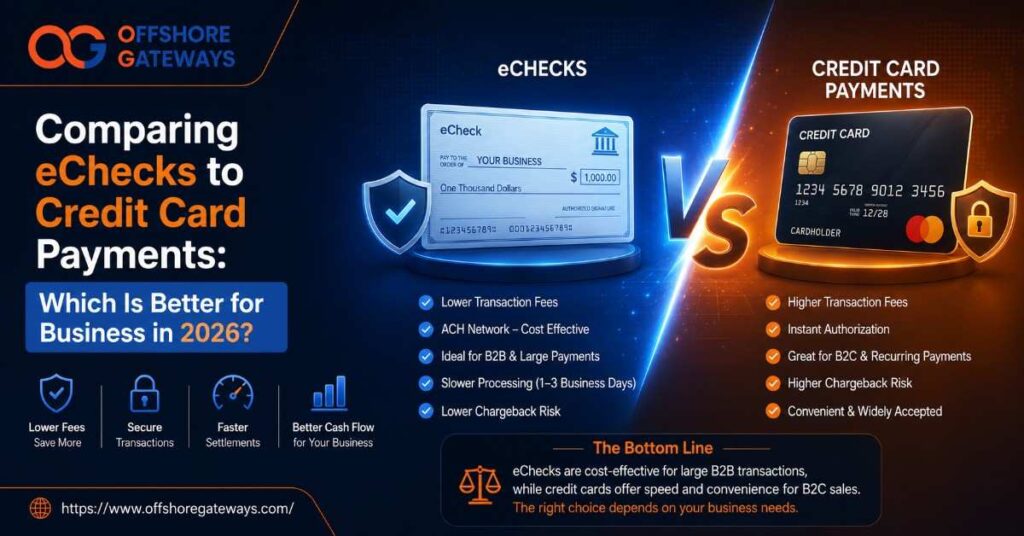
Comparing eChecks to Credit Card Payments: Which Is Better for Business in 2026? Adaptable payment options remain an important lifeline for customers in this modern business competitive environment. Businesses must identify the type of payment that best fits both their operational needs and those of their customers.Two options exist as preferred choices: eChecks and credit cards. Each comes with its own advantages and disadvantages, depending on the business’s specific requirements. Let’s now compare in detail to determine which service, pay with eCheck online or accepting credit card payments through credit card processing companies is better. What Are eChecks? An e-check is the electronic version of a check or a paper check. A system that does not depend on hard checks requires the money to be transferred electronically from a customer’s checking account to the bank account of that business. This would have helped businesses accept eCheck payments from clients who wanted to pay directly from their checking accounts. Pay with eCheck online is growing in popularity because it offers a hassle-free, safe, and inexpensive method of payment. Much like a paper check, an e-check uses the account number and routing number of the payer’s bank. Although faster and less expensive than a traditional paper check, an e-check is even cheaper and faster. Advantages of Accepting eCheck Payments Lower Processing Fees: Compared to credit card transactions, the processing fees of eChecks usually are much lower. Considering that businesses associated with high-ticket items or big volumes of transactions accept eCheck payments can notably save considerable operating costs. Security: eChecks are granted the same protection levels of paper checks wherein lies the regulation E and the safety measures instituted within ACH’s safety procedures. This will be able to safeguard personal data and eliminate opportunistic fraud platforms. Faster Settlements: Traditional checks can take anywhere from days to clear, whereas eChecks typically settle in 1 to 2 business days. Faster than most paper checks and comparable to some credit card processing companies. Drawbacks of EChecks Longer Clearing Times than Credit Cards: While eChecks are much faster than paper checks, they also take a couple of days to clear, whereas credit cards, and quite frequently, offer near-instant authorizations. Not So Frequently Used: Pay with eCheck online is becoming trendy, but not all businesses or consumers know of it. Sometimes there is a need to target education at the consumers so that they become comfortable in using this facility. What Are Credit Card Payments? The credit cards provide access to the customers’ own Visa, MasterCard, or other credit card as a means of payment. Business credit card transactions are typically supported by credit card processing companies which guarantee the transfer of funds promptly and safely from the customer to business. Credit card payments are accepted anywhere, so therefore, the customers will definitely enjoy the convenience and ease of it, which in some cases leads to winning higher chances of sales. The acceptance of credit card methods for payment is indeed a given to most high-volume transaction businesses. Advantages of Credit Card Payments Widespread Acceptance: Almost every consumer is accustomed to paying by credit card. A firm that accepts credit cards can therefore reach and serve a far greater population of consumers. Faster Transactions: Credit card sales can be authorized for seconds, and typically this amount is settled into the business’s account in a couple of business days. Increased Sales Potential: Since credit cards allow consumers to pay in installment, consumers are more likely to make bigger purchases. Moreover, most consumers prefer credit cards because of the reward points or the convenient option for deferring payment, like Care Credit application. Drawbacks of Credit Card Payments Higher Processing Fees: Credit card processing tends to collect higher fees than an eCheck, especially for those businesses involved in high volumes of transactions or larger payments. Those processing fees may eat into the bottom line, making the credit cards pretty costly to do business. Chargebacks: Credit card payment entails the loss of chargebacks, where customers dispute a transaction and receive a refund, leaving businesses time and money to waste. Complex Security Requirements: Credit card firms are sensitive with regard to dealing with customer data. In handling cardholder information, therefore, companies have to adhere to PCI DSS standards so that consumers’ information is held with safety. Cost Comparison: EChecks vs. Credit Cards It’s all about the cost when it comes to the choice between pay with eCheck online and credit card acceptance. For those businesses running on thin margins and processing large transactions, the difference these processing fees make is at least significant. ECheck Fees: The cost for eChecks ranges between $0.30 and $1.50, and only a tiny percentage-mostly 0.5%-of that. For the vast majority of transactions, this makes eChecks very attractive for larger transactions because it caps the fee level below credit card levels. Credit Card Fees: From 1.5% to 3.5% of the amount, depending on the type of card and on the credit card processing company. Along with such a percent-based charge, there may be flat fees, which again would add cost to the user’s account. These can make a credit card pretty expensive for larger-value transactions. Transaction Speed: EChecks vs. Credit Cards Regarding speed, the transactions will sometimes favor credit cards. Truly, authorization for credit card transactions occurs within mere seconds and the funds are immediately available to a business. Echecks take 1-3 business days to clear, thus retarding cash flow. This will be unbearable to most small businesses that need capital fast to finance operations. Yet, the cheaper cost seems a better tradeoff against the slower speed of transaction of an eCheck. This will thus be convenient for businesses that only require access to the funds later. Security: Which Is Safer for Your Business? First and foremost, safety would be a concern when it comes to choosing the payment mode. Both eChecks and credit card transactions are pretty secure in nature; however, the way they would be processed is different. eChecks: Here also the safety rules and regulations
What is the Merchant Bank Account for Gambling & Forex benefits?
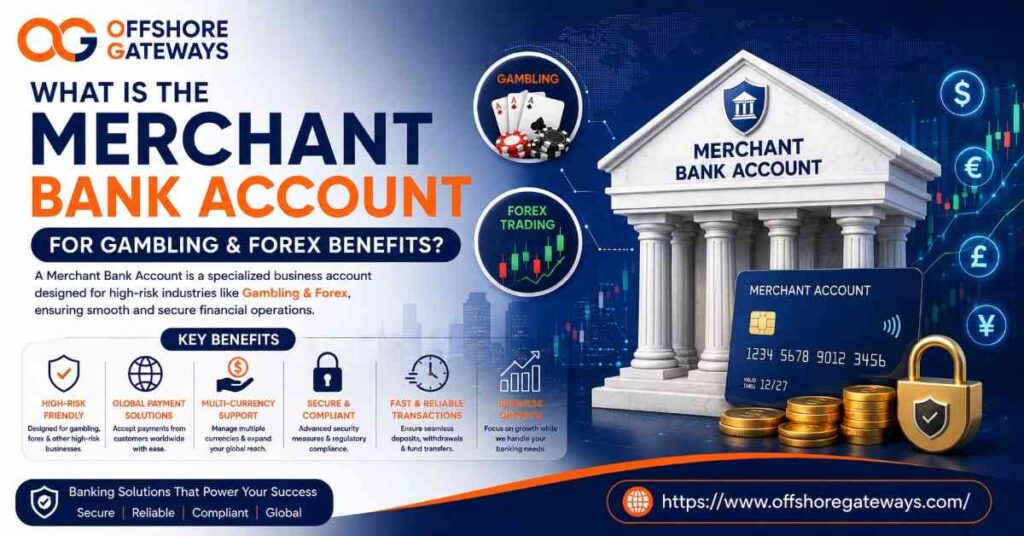
What is the Merchant Bank Account for Gambling & Forex benefits? In the fast and hyper-competitive environment of Forex trading and gambling, a player’s access to the right financial tools will either make or break their fortunes. One of such highly essential finance instruments is the Merchant Bank Account. This specialized kind of account provides rare benefits with its consideration of the risk element in gambling and Forex. So, what actually is a Merchant Bank Account, and how can it help your business? Let’s delve deeper into this and explain merchant bank operations along the way. Understanding Merchant Bank Account A Merchant Bank Account is specifically a type of bank account that an online business allows credit card users to have. Merchant bank accounts are primarily significant in businesses, especially where applications are made in either gaming or Forex. To understand this concept better, let’s explain merchant bank functions in more detail. Merchant banks essentially function as an intermediary between the business and the credit card companies. They facilitate the process of acceptance of payments from customers and transferring these payments directly to the business’s account. The role is therefore important to any company that seeks to take on credit card payments-whether in-person or online. The Unique Challenges of Gambling and Forex Industries Before entering into the merits of Merchant Bank Account for gaming and Forex business, it would be important to understand some of the significant difficulties each industry faces: High-risk classification Regulatory scrutiny Chargebacks and fraud International transactions Fluctuating cash flows These issues offer massive headaches for gambling and Forex businesses trying to access traditional banking services. It is at this point that special Merchant Bank Accounts are used. Benefits of Merchant Bank Accounts for Gambling and Forex Now that we have laid the groundwork, let’s explore the specific benefits. Merchant Bank Account provides gambling and Forex operations with: Risk Management:- Merchant Bank Account is designed to handle the higher risk associated with gambling and Forex transactions. These accounts often come with advanced fraud detection and prevention tools, helping businesses minimize losses due to fraudulent activities. International Transactions:- A Forex business must be able to execute the international transaction without any hassles. Merchant Bank Account usually possess multi-currency facilities and exchange rates, that facilitate easier business operations with international entities. High Volume Processing:- Businesses of gambling and Forex often engage in numerous transactions. Merchant Bank Account is made for such a heavy volume, ensuring that operation would run out smoothly and effectively during peak time. Chargeback Protection:- Chargebacks are among the best threats in the high-risk industry. Many providers of Merchant Bank Account offer chargeback protection services, which really help companies minimize loss and have a good relationship with credit card companies. Compliance Support:- A major issue in the gambling and Forex industries remains compliance with various regulations. Merchant Bank Account providers usually not only offer their service but also provide compliance support, helping businesses navigate the complex regulatory landscape. How to Choose the Right Merchant Bank Account This is an important decision regarding the selection of the appropriate Merchant Bank Account for your gambling or Forex business. Keep reading to learn more: Fees and Rates:- Compare the fee structures and rates of different providers. Strive for clearly communicated prices; avoid providers with a lot of hidden fees. Processing Volume:- Make Sure that the account can support your expected volume of transactions, particularly in peak times. Security Features:- Look for strong security measures, such as encryption, Fake detection, and chargeback protection. Integration Capabilities:- Make sure to choose a provider that simplifies integration with your current system and platforms. Customer Support:- Opt for a provider with responsive customer support, preferably available 24/7. Setting Up Your Merchant Bank Account Once you have chosen your provider, setting up of your Merchant Bank Account normally involves the following process: Application Submission Document verification Underwriting process Account authorization Integration and testing It should be noted that high-risk industries, such as those of gambling and Forex, may take a little longer to get approved than low-risk businesses. Best Practices for Managing Your Merchant Bank Account All your Merchant Bank Account is capable of being maximized with these best practices: Check transactions often Adoption of robust fraud prevention measures: Stay compliant with industry regulations Clear communication with the account provider. Manage periodic review and optimisation of payment processes. The Role of Payment Processors Although Merchant Bank Account are essential, most often than not work in tandem with payment processors. They process the transaction involving a credit card. Important considerations when choosing a payment processor include: Compatibility with your Merchant Bank Account Processing fees Supported payment methods Security features Ease of integration Bank Per Accounts The Future of Merchant Bank Accounts in Gambling and Forex Changes in regulations, technology, and other factors in society will continue to influence the shaping of Merchant Bank Account in gambling and Forex. Trends to watch for include: Increased use of artificial intelligence for fraud detection Integration of blockchain technology for enhanced security Greater emphasis on mobile payment processing Expansion of alternative payment methods Overcoming Common Challenges Nevertheless, companies dealing with gambling and Forex business activities that employ Merchant Bank Account may experience some issues. Here are a few common issues and their possible solutions: High fees: Look for competitive fees and negotiate with vendors by your volume of transactions. Account freezes: Freezing accounts Make sure to communicate and uphold the necessary policies with your provider so as to not freeze an account. Limited provider options: Fewer merchant account providers: Work with an approved payment gateway processor, such as Offshore Gateways, to gain access to a wider variety of Merchant Bank Account options tailored to your industry. Regulatory changes: Keep oneself updated with the changes occurring in regulations and discuss with an account provider to ensure that compliance is active. The Global Perspective: International Merchant Account Setup For most gambling and Forex businesses, the operation has to be global. Opening up international merchant accounts is tough work but absolutely necessary
Effortless Credit Card Payment Processing for Your Business
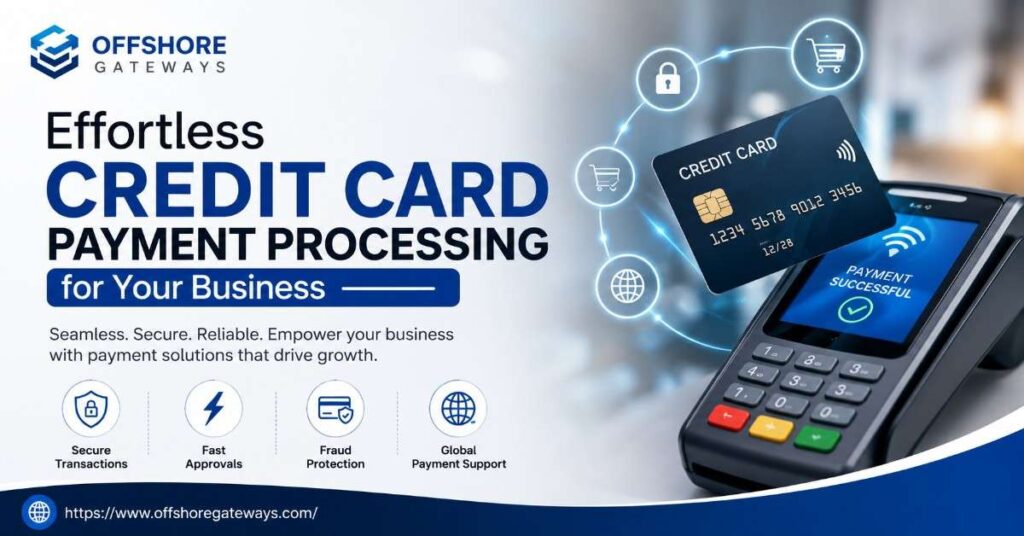
Effortless Credit Card Payment Processing for Your Business Indeed, of the basic things of modern commerce, Credit Card Payment Processing is really so since millions of transactions occur daily. To organizations that operate under the fast-moving environment of e-commerce, mastering Credit Card Processing means more than an indispensable act; it becomes one of the critical elements to ensure smooth operations for customer satisfaction. In this all-inclusive guide, we try to understand the basics of Credit Card Payment Processing followed by offering practical tips on how one can make the system easier in payments and discuss how a right service provider makes the process easy. Understanding Credit Card Payment Processing: A Simplified Overview Credit Card Payment Processing is just a series of virtually simultaneous activities that take place anytime a customer buys anything using their credit card. Here’s the breakdown: Authorization: Based on the payment to be made, the customer fills in their card details. After this, the information is considered by the processor and sent to the bank-issuer to check whether the transaction can be authorized. Then the validity of the card is checked, and the accessibility of funds or credit by the customer. Authentication: This is where a bank will request more information to verify a transaction, such as requesting a CVV number from an individual, or perform two-factor authentication to identify who the card holder is. Approval or Decline: In accordance with the response from the bank, further proceeding is either authorized or rejected. If it is rejected, the amount reflects on hold and gets deducted from the customer’s account. Settlement: Finally, at the end of the day, the merchant bank forwards all the transactions to the credit card network. After that, settlements occur between the cardholder’s bank and merchant account. This money will be wired into your account in a couple of days. Funding: Finally, the proceeds from the sale are credited to the merchant’s bank account, completing the entire transaction process. Common Challenges in Credit Card Processing While these may sound very simple, there are various different issues that businesses commonly have to address. High Transaction Fees: The costs involved in Credit Card Processing have become extremely high, especially for small businesses. This includes interchange fees, assessment fees, and payment processor fees. Fraud and Chargebacks: Each fraudulent transaction and chargeback is costly for a business. Insecurity might leave companies with such huge losses if proper security is not set in place. Complex Setup: Setting up a payment processing system with an e-commerce or point-of-sale system can be quite complex, particularly for the companies lacking IT resources. How to Optimize Your Credit Card Payment Processing System These following tips makeCredit Card Payment Processing smooth and reasonable: 1. Choose the Right Payment Processor A good payment processor is one that can meet business needs. Some of its features would be: Transparent Pricing: The processor should have clear, upfront pricing with no hidden fees. Comparisons between providers can be made to get the best rate for your transaction volume. Comprehensive Security Measures: The wave of credit card fraud demands the possessing processor to have the highest infrastructural functionalities regarding security features, which include encryption, tokenization, detection of fraud mechanisms, among others. Seamless Integration: be it either online, in-store, or probably both in an omnichannel experience meant that all of this should seamlessly fit into the existing infrastructure with less manual intervention. 2. Implement PCI Compliance PCI DSS stands for (Payment Card Industry Data Security Standard). All businesses that will have a need to handle credit card information are under obligation to observe the set requirements. The requirements protect your business against data breaches and possible fines. To comply with PCI: Secure Data Storage: Data storage should be avoided to the barest minimum and never with sensitive credit card details like a full card number or even the CVV code, unless it is necessary and is encrypted. Regular Security Audits: Periodic auditing of the payment systems to ensure that probable loopholes are detected and curtailed. Employee Training: he employees should be trained on why PCI compliance is important and how to handle sensitive payment information. 3. Optimize for Mobile Payments Besides, with the rapid growth of mobile e-commerce, the process of checkout on mobile also needs to be seamless. Ensure that the design of this payment gateway is mobile-friendly; one must be able to check out very smoothly and securely using either iPad or Android-based Smartphone. Responsive Design: The page should adapt itself automatically to the dimensions of the device on which the charge is to be made. Simplified Payment Process: Reducing the number of steps a user needs to go through in order to make any kind of payment through mobile. Introduce address autocompletion, stored modes of payment, etc. 4. Leverage Tokenization Tokenization is the process of replacing sensitive financial information with a unique identifier, known as a “token,” for a transaction to be completed quickly and securely without exposing actual card data. It helps minimize data breaches. Enhanced Security: Tokenization ensures that even if a hacker accesses your payment information, the real details he will get are beyond his reach. Streamlined Payments: Tokenization does make the return customer checkout process so much smoother that one-touch payments are feasible. Practical Tips to Further Improve Your Credit Card Processing Efficiency 1. Negotiate Better Rates with Processors This could be a very strong point in negotiating better fees with your processor if you process large volumes of transactions. It goes without saying that an unchanging rate of dealing and a low chargeback rate will empower you to negotiate the best rates possible. Bundle Services: If you take a number of services from one vendor say, payment processing with merchant services you may try to negotiate some discount. Review Statements Regularly: Carefully examine your periodic payment processing statements for any unusual fees or rate increases and ask your processor. 2. Utilize Payment Analytics Also, most payment processors will come with the capability of querying data on your transactions through analytics tools. Identify
Payment Gateways Providers in Liverpool ( 2026 )
A business has to be very particular with choosing Payment Gateways Providers in Liverpool so far as online financial transaction management is concerned. This becomes focused because the right provider can make a difference in whether your transactions get processed smoothly, their security, and then the satisfaction of your customers. In this post, we try to wade through some of the best payment gateway options available in Liverpool for your selection, focusing on the needs of your business. Understanding Payment Gateways: Before reviewing the different Payment Gateway Providers in Liverpool, let’s first know what a payment gateway does. In other words, a Payment Gateway is an instrument that approves payments for e-businesses, on the Internet, or via traditional live retailing. It takes up, in a secure manner, the customer’s payment information, validates a transaction, and then passes that information on to the acquiring bank. It is, therefore, cardinal for any business in Liverpool to opt for appropriate Payment Gateways Providers in Liverpool to make sure that the transactions go on smoothly, ensure customer confidence, and explore new markets. Whatever gateway you go for-from an e-commerce start-up to established retailers-the ramifications could be pretty significant. Key Features to Look for in Liverpool Payment Processing Solutions Some of the features you should expect from any service you choose in Payment Gateway Providers in Liverpool include; Top Payment Gateways Providers in Liverpool 1. Offshore Gateways Offshore Gateways is among the well thought of industry players in Payment Gateway Providers at Liverpool, and hence is a strong and sound platform, especially popular with technically-savvy businesses. It supports Credit Cards, Debit Cards, and Digital Wallets such as Apple Pay and Google Pay. Why Choose Offshore Gateways? Considerations: 2. PayPal PayPal is one of the most recognized brands for user-friendliness and wide acceptance in online payment processing. The application of PayPal can be recommended to any size of business in Liverpool. Why Choose PayPal? Considerations: 3. Square Square is an agile payment gateway that, until lately, has extended its operations to web and in-person payment solutions, so it’s a favorite for businesses operating both brick-and-mortar and e-commerce sites. Why Choose Square? Considerations: 4. Worldpay Worldpay, now a part of FIS, is one of the leading Payment Gateway Providers in Liverpool, known for its comprehensive solutions that cater to businesses of all sizes. Why Choose Worldpay? Considerations: 5. Braintree Braintree is a portable integration payment platform famous for its ease of integration; they really love working from a developer’s point of view. Why Choose Braintree? Considerations: Payment Gateway Service in Liverpool: Legal and Compliance Considerations Considerable regard should be taken to the legal and regulatory section while selecting Payment Gateways Providers in Liverpool. A payment gateway has to correspond to a lot of regulations touching finance, both locally and globally; these include PCI DSS and all other particular regulations touching AML and KYC requirements. Key Considerations: The Future of Payment Gateways in Liverpool: Trends to Watch The payment gateway’s industry is continuously developing with technology and a change in consumers’ behavior. In such a backdrop, there are the following trends to be watched out for in the future by businesses in Liverpool: 1. More acceptance of e-wallets 2. Improved security features 3. Interface with Emerging Technologies 4. Customized Payment Solutions Practical Tips for Choosing the Best Payment Gateway for Your Business The choice of the right Payment Gateway Providers is among the most important strategic decisions that can influence your business. Here are some practical tips to help guide your decision: 1. Analyze Your Business Needs 2. Comparative Costs 3. User Experience Evaluation 4. Consider Customer Support 5. Look for Added Value Conclusion: For Your Business Make the Right Choices It’s hugely important to get the choices right around the Payment Gateway Provider in Liverpool. Where there is clarity and comparison of different solution providers, a business will be best placed to select, finally, the combination that will wholesale best in adding significant value to the customer experience. Whether using an established company like Offshore Gateways or PayPal, or something more focused like Offshore Gateways; the key is to implement something that can provide both function and security along with the proper level of support needed by your business. Keep in mind the success stories of those businesses that have made the right choice, as you will actually surf through the process, using the experiences of others to guide your own decision-making. Frequently Asked Questions (FAQs)