
Have you ever had a legitimate international transaction declined for no clear reason? Or watched a customer abandon their cart because your payment gateway doesn’t support their currency? These are real problems that cost businesses millions every year and they’re pushing smart entrepreneurs toward offshore payment solutions faster than ever before.
Offshore payment solutions are no longer just for high-risk industries or large multinationals. Small and mid-sized businesses across India and the world are making the switch because the benefits are simply too good to ignore. Whether you’re selling software subscriptions, running an e-commerce store, or offering financial services, the right offshore payment gateway can completely transform how money flows through your business.
This guide breaks down exactly why global businesses are making this move and what it means for you.
What Are Offshore Payment Solutions, Really?
Let’s clear up a common misconception. Offshore payment solutions are not about hiding money or dodging taxes. They are legitimate financial tools that allow businesses to accept payments through banks or processors registered in a different country than where the business operates.
A simple example: an Indian digital marketing agency might use an offshore merchant account registered in the UK or Cyprus to accept payments from US and European clients. This gives them access to multi-currency billing, lower interchange fees, and fewer restrictions compared to domestic processors.
International payment processing through offshore channels often comes with greater flexibility in which industries are served, which payment methods are accepted, and what currencies can be processed. Think of it as upgrading from a local taxi to a full international ride network.
Why Businesses Are Making the Switch: 7 Reasons
1. Access to High-Risk Industry Support
Many domestic banks and payment processors automatically reject businesses in industries they classify as “high-risk”-including online gaming, Forex, nutraceuticals, travel, adult entertainment, and even some subscription-based SaaS companies. If your business falls into one of these categories, a high-risk payment gateway offered through offshore channels may be your only viable option for smooth, uninterrupted processing.
A Forex trading platform based in Mumbai, for example, will find it nearly impossible to get reliable domestic processing. By partnering with an offshore payment gateway provider, they can secure stable processing, handle chargebacks more efficiently, and keep their cash flow intact.
2. Multi-Currency Payment Capabilities
Does your business accept payments in USD, EUR, GBP, AED, or AUD? If you’re relying on a standard domestic gateway, you’re likely paying steep conversion fees and losing customers who prefer to pay in their local currency.
Multi-currency payment gateway solutions-a core feature of most offshore payment solutions allow you to display prices and accept payments in dozens of currencies simultaneously. This reduces cart abandonment, builds trust with international customers, and eliminates the confusion of forced currency conversions.
3. Lower Transaction Fees and Better Rates
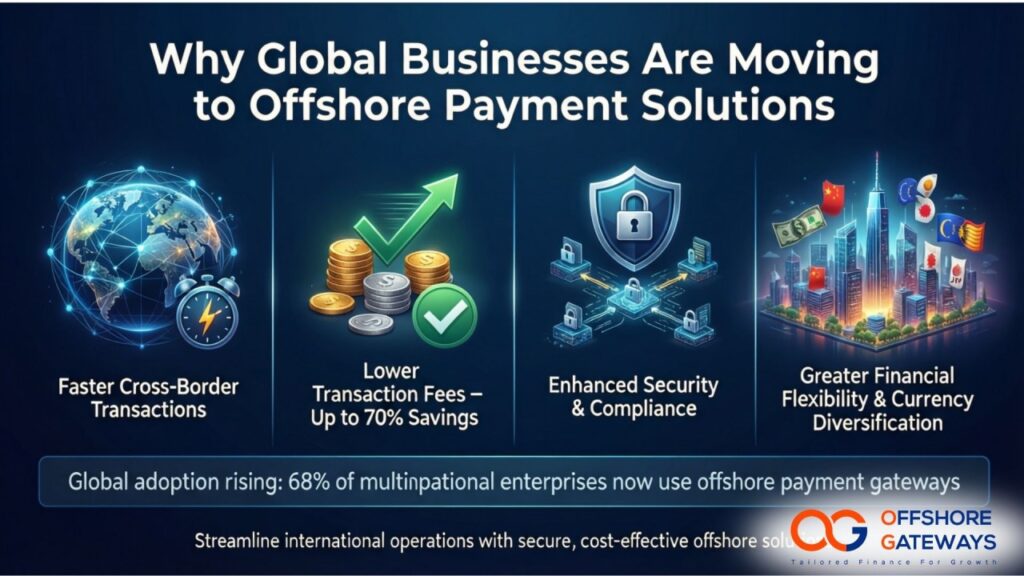
This one surprises many business owners. Offshore payment processors often offer significantly lower transaction fees than domestic alternatives-especially for cross-border transactions. Because they operate in jurisdictions with favorable financial regulations, they can pass those savings on to merchants.
For a business processing $100,000 per month in international transactions, even a 0.5% reduction in fees saves $6,000 per year. Scale that up and you’re looking at a very real competitive advantage.
4. Fewer Restrictions, More Approvals
Domestic banks often impose strict merchant category codes (MCCs) that determine what kind of business you can run and how much volume you can process. Cross-border payment solutions offered by offshore providers typically come with far greater flexibility.
Many businesses report that their international approval rates jump dramatically after switching to offshore payment solutions-in some cases from 60% to over 90%. For e-commerce businesses especially, that difference in approval rate directly translates to revenue.
5. Better Chargeback Management
Chargebacks are the silent killer of online businesses. A high chargeback ratio can get your account terminated by a domestic processor with very little warning. Offshore payment solutions are often better equipped to handle chargeback-heavy industries, offering dedicated risk management tools, chargeback alerts, and dispute resolution support.
This is particularly relevant for Indian businesses selling internationally, where disputes can arise from time zone differences, language barriers, or varying consumer protection laws.
6. Geographic Redundancy and Uptime
What happens when your payment processor goes down? For most businesses using a single domestic gateway, the answer is: you stop making money. Global payment processing solutions through offshore providers typically offer redundant systems across multiple geographies, dramatically reducing downtime and ensuring that payments keep flowing even if one system experiences issues.
7. Financial Privacy and Asset Protection
Legitimate businesses operating in politically or economically volatile regions often seek offshore banking solutions as a form of financial protection. This is about legal risk management ensuring that business funds aren’t frozen or disrupted by local regulatory changes or banking crises. Countries like Cyprus, Malta, Seychelles, and the Cayman Islands offer stable financial environments that many businesses find attractive for this reason.
Who Benefits Most from Offshore Payment Solutions?
Not every business needs to go offshore but for many, it’s the single most impactful decision they can make for their payment infrastructure. Here’s a quick breakdown of who benefits most:
E-commerce Businesses selling across multiple countries need multi-currency support and high approval rates. Offshore solutions deliver both. An Indian Shopify merchant selling to customers in the US, UK, and Australia can consolidate their international payment processing into a single, efficient offshore gateway.
SaaS Companies and Subscription Businesses dealing with recurring billing, free trials, and subscription cancellations face a higher-than-average chargeback risk. A well-configured offshore payment gateway with recurring billing tools is designed exactly for this use case.
Travel and Hospitality Businesses are considered high-risk by most domestic processors due to advance bookings and high cancellation rates. Cross-border transaction solutions tailored for the travel industry make processing seamless.
Forex and Crypto Platforms face the most restrictions domestically and have the most to gain from offshore processing. For these businesses, offshore payment solutions are essentially non-negotiable.
Common Questions About Offshore Payment Solutions
Are offshore payment solutions legal in India: Yes, using offshore payment solutions is legal for Indian businesses engaged in legitimate international trade. However, businesses must comply with FEMA (Foreign Exchange Management Act) regulations and report foreign earnings appropriately. Always consult a financial or legal advisor for your specific situation.
How do I set up an offshore merchant account: Setting up an offshore merchant account typically involves choosing a jurisdiction, submitting business documentation (including incorporation documents, ID proof, processing history, and a business plan), and passing a compliance review. Reputable providers like Offshore Gateways guide businesses through this entire process step by step.
What is the difference between a domestic and offshore payment gateway: A domestic payment gateway processes transactions through a bank or processor registered in your home country. An offshore payment gateway uses a processor registered in another jurisdiction — often with more favorable regulations, lower fees, and broader support for international transactions and high-risk industries.
How long does it take to get approved for offshore payment solutions: Approval timelines vary by provider and industry. Standard businesses may be approved within 5–10 business days. High-risk businesses can expect 2–4 weeks for thorough underwriting. Having clean documentation and a solid processing history speeds up the process significantly.
Can I use offshore payment solutions for my Indian business: Absolutely. Many Indian businesses- particularly in IT services, digital products, consulting, and e-commerce-use offshore payment solutions to accept international payments more efficiently. The key is working with a provider that understands Indian regulatory requirements alongside international processing standards.
The Role of Offshore Banking Solutions in Business Stability
Beyond just accepting payments, offshore banking solutions provide businesses with a financial foundation that’s insulated from local disruptions. Imagine running an export-focused business and waking up to a banking freeze due to a domestic regulatory action. An offshore bank account keeps your international operations running independently.
This is not a fringe strategy. Large Indian IT companies, pharmaceutical exporters, and even some startups routinely maintain offshore financial structures for exactly this reason. The combination of offshore banking solutions with a solid global payment processing setup creates a resilient financial architecture that most domestic-only setups simply can’t match.
How to Choose the Right Offshore Payment Gateway
Not all offshore providers are created equal. Here’s what to look for:
- Regulatory Compliance: Your provider must be licensed and compliant in their operating jurisdiction. Ask for their license numbers and verify them independently.
- Currency Coverage: Ensure they support the currencies your customers use. A solid multi-currency payment gateway should support at minimum USD, EUR, GBP, AUD, CAD, and AED.
- Chargeback Support: Look for providers offering chargeback alerts, dispute management tools, and dedicated risk management teams.
- Integration Options: The gateway should integrate easily with your existing e-commerce platform, CRM, or billing system. API documentation should be thorough and developer-friendly.
- Transparent Pricing: Avoid providers who bury fees in complex pricing structures. Rolling reserves, setup fees, monthly minimums, and refund fees should all be clearly disclosed upfront.
- Reputation and Reviews: Look for case studies, client testimonials, and third-party reviews. A provider worth trusting will have a verifiable track record.
Real-World Example: An Indian EdTech Company’s Experience
Consider a hypothetical and very realistic scenario. An Indian EdTech startup selling online courses to students in the US, UK, and the Middle East was struggling with a 65% international approval rate and constant complaints about currency conversion fees.
After switching to offshore payment solutions with a multi-currency payment gateway, their approval rate climbed to 89%. They eliminated currency confusion by billing in local currencies. Their monthly revenue increased by 22% within three months not because they got more traffic, but because they stopped losing customers at checkout.
This is the practical power of international payment processing done right.
Conclusion: The Right Move for Global Ambitions
If your business operates across borders or plans to relying solely on domestic payment infrastructure is a significant handicap. Offshore payment solutions give you the tools to compete globally: multi-currency support, high approval rates, lower fees, and the stability to handle the unexpected.
The shift toward offshore payment solutions isn’t a trend, it’s a structural change in how smart businesses manage their financial operations. Companies that make this move early gain a real competitive edge. Those that wait often find themselves losing customers to competitors who figured it out first.
Whether you’re exploring your first offshore merchant account or looking to optimize an existing offshore payment gateway setup, the resources and expertise you need are available right now.
Take Action Today
Ready to explore what offshore payment solutions can do for your business? Visit Offshore Gateways to learn more about their full suite of cross-border payment solutions, high-risk processing options, and international payment processing services. Their team works directly with Indian and global businesses to find the right payment infrastructure for every situation.
Don’t let payment friction cost you another sale. Call now or visit offshoregateways.com to get started.
FAQ :- Offshore Gateways
Yes, offshore payment solutions are completely legal for Indian businesses engaged in international trade and digital exports. Businesses must comply with FEMA (Foreign Exchange Management Act) guidelines and properly report foreign income. When you work with a licensed, regulated offshore payment gateway provider, your transactions are processed through legitimate banking channels with full compliance support. Always choose a provider that understands both international regulations and India-specific requirements.
A domestic payment gateways processes transactions through a bank registered in your home country and typically supports only local currencies with limited international reach. An offshore payment gateways, on the other hand, operates through a financial institution in another jurisdiction — offering multi-currency support, higher international approval rates, lower cross-border transaction fees, and access for businesses in industries that domestic processors often reject, such as Forex, gaming, travel, and SaaS.
Approval timelines depend on your business type and the completeness of your documentation. Standard low-risk businesses are typically approved within 5 to 10 business days. High-risk businesses such as those in Forex, online gaming, or nutraceuticals can expect a more thorough underwriting process that takes 2 to 4 weeks. Submitting clean business documents, a solid processing history, and a clear business model significantly speeds up the process.
Absolutely. Small and mid-sized Indian businesses selling digital products, software, consulting services, or physical goods internationally benefit tremendously from offshore payment solutions. The multi-currency payment gateway features alone reduce cart abandonment from foreign customers. Add in lower transaction fees and higher approval rates, and even a business processing $10,000 per month internationally will see a meaningful improvement in revenue and customer experience.
Most offshore payment providers require the following: a valid government-issued ID and proof of address for all directors, business incorporation documents, a working website with clear terms and conditions, a privacy policy and refund policy, recent bank statements (typically 3 to 6 months), and a description of your products or services. High-risk businesses may also need to provide processing history, chargeback ratios, and a business plan. Providers like OffshoreGateways.com walk you through the exact documentation checklist for your specific industry.
