
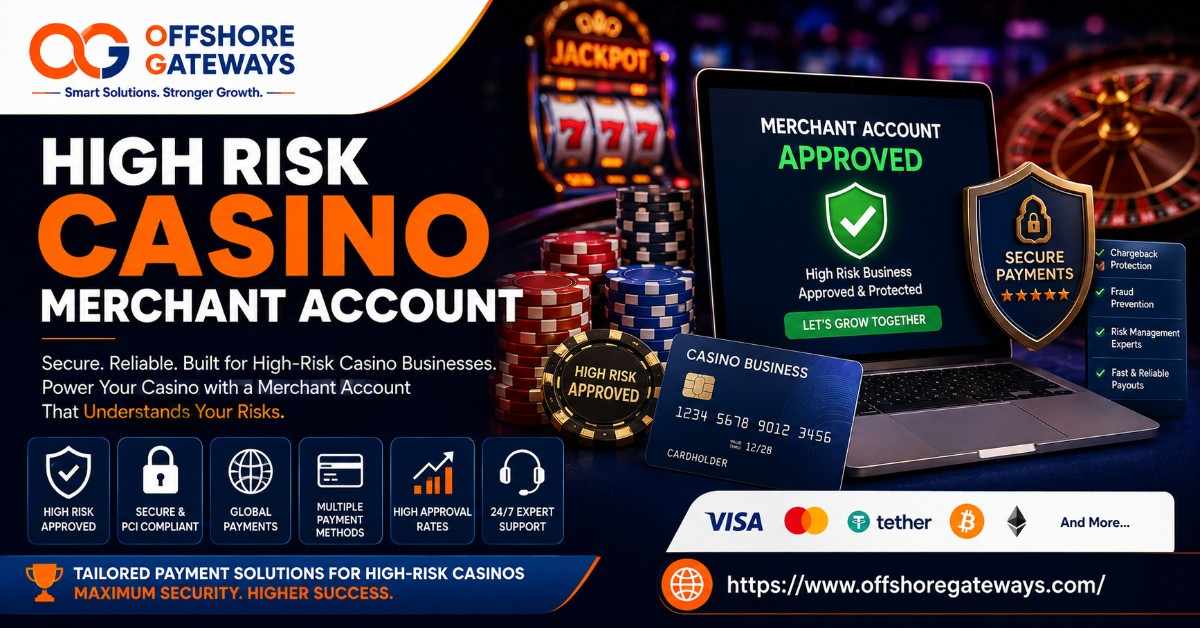
Getting a high risk casino merchant account approved is harder than most people expect. Most operators applying for the first time make the same mistakes. Offshore Gateways has seen this play out across hundreds of applications – and the patterns are very consistent. Not because casinos are shady. Because the entire banking system is built to reject you by default.
Here is what actually happens – and what you can do about it.
Let’s start with a term most operators learn the hard way: de-banking.
What does de-banked mean? It means your bank closes your account – not because you broke any law, but because your business category makes them nervous. Offshore Gateways works specifically with businesses that have been through this – it is one of the most common reasons operators come to us. No warning. No appeal process. Just a letter and a deadline.
What does debanked look like in practice for a casino operator? Your processing stops. Payouts freeze. Players cannot deposit. Your entire revenue stream goes dark while you scramble for a replacement.
De banking is not rare. According to the Financial Conduct Authority, UK banks closed over 1,000 business accounts per business day in 2021-2022 – and gambling operators were disproportionately affected.
The problem is not your business. It is your category.
Card networks use Merchant Category Codes to classify every business.
MCC 7995 is the gambling code. The moment an acquirer registers you under it, automated systems at Visa and Mastercard immediately flag every transaction for enhanced monitoring. Interchange fees go up. Approval thresholds tighten. Standard processors quietly push you to the back of the queue.
This is why a travel merchant account or even a CBD merchant account – both of which Offshore Gateways also supports – sometimes gets approved faster than a casino. Travel and CBD are high-risk, but their MCCs do not trigger the same automated scrutiny that 7995 does.
You cannot avoid MCC 7995. Applying for a high risk casino merchant account through a provider who already works within these acquiring relationships is the only practical route forward.
Most operators apply for the wrong type of account.
A standard business account is built for in-person transactions and low-risk e-commerce. An internet merchant account UK is specifically structured for card-not-present environments – which is every single transaction a casino processes.
This matters even more if you are serving British players. UK acquiring banks assess gambling businesses under the Financial Conduct Authority’s oversight. Your application gets cross-referenced against your UK Gambling Commission licence status before anything else happens.
No valid UKGC licence? Your application is rejected before an underwriter even reads it.
The casino merchant account approval process is not complicated. It is just badly explained by most providers.
Here is what actually happens when you apply for a high risk casino merchant account the right way:
With a specialist provider, this runs 5-10 business days. With a generic processor, it can stretch to 8 weeks – and still end in rejection.
This one surprises people.
Your billing descriptor – the text that appears on a player’s bank statement when they make a deposit – is reviewed during underwriting. A descriptor that does not clearly identify your business gets flagged immediately.
Your statement descriptor should match your brand name, your website domain, or your trading name. “Online Services Ltd” appearing on a player’s bank statement instead of your actual casino name is a guaranteed chargeback trigger – and underwriters know it.
Fix your billing descriptor before you apply. This is a small thing that kills more applications than most operators realise.
A pre-check of your billing descriptor and statement descriptor before submission can save your entire application – this is standard practice for specialist providers.
Every high risk casino merchant account comes with a rolling reserve – no exceptions for new applicants. That is just reality.
Typical range: 5-10% of gross monthly volume, held for 90-180 days. The reserve releases on a rolling schedule as each holding period expires.
What most providers do not tell you upfront: you can negotiate a reserve review clause at the six-month mark. If your chargeback ratio has stayed below 0.8% and your volume has been consistent, you have real leverage to reduce the reserve percentage.
Ask for this in writing before you sign the contract. If a provider refuses to include a review clause, that tells you everything about how they plan to treat you long-term.
Getting approved is step one. Staying approved is the actual challenge.
The first 90 days of your high risk casino merchant account are a probationary window – whether your provider tells you that or not. Your chargeback ratio is monitored daily. Volume spikes without prior notice trigger automated reviews. Sudden changes in player geography raise flags.
Keep your ratio below 0.8%. Your acquirer’s internal limit for a high risk casino merchant account is almost always stricter than Visa’s 1.5% VAMP threshold, effective April 2026.
The casino merchant account approval process does not end when you go live. It continues for the entire relationship.
Need a second processor for redundancy? A backup acquiring channel means a single provider failure does not take your entire operation offline.
A specialist provider does not run generic applications through a single acquiring bank and hope for the best.
Every high risk casino merchant account application is matched to specific acquiring partners who already process for your vertical – gaming, sportsbook, poker, or lottery. Your MCC 7995 registration is expected, not treated as a red flag.
Rolling reserve terms, billing descriptor checks, licence verification, and AML documentation review all happen before submission – not after rejection.
If your account has been terminated, if you are currently de banking a previous processor relationship, or if you are setting up for the first time – Offshore Gateways handles the full process.
Follow Offshore Gateways on LinkedIn for the latest updates on high-risk payment solutions and industry insights.
Enabling fast, secure payments and tailored solutions—empowering your business to grow worldwide, no matter the challenge.
Copyright © 2026. All rights reserved.